CHS SGA member Chris Prowell interviews County Commission candidates
PROTECTED CONTENT
If you’re a current subscriber, log in below. If you would like to subscribe, please click the subscribe tab above.
Username and Password Help
Please enter your email and we will send you a password reset link.
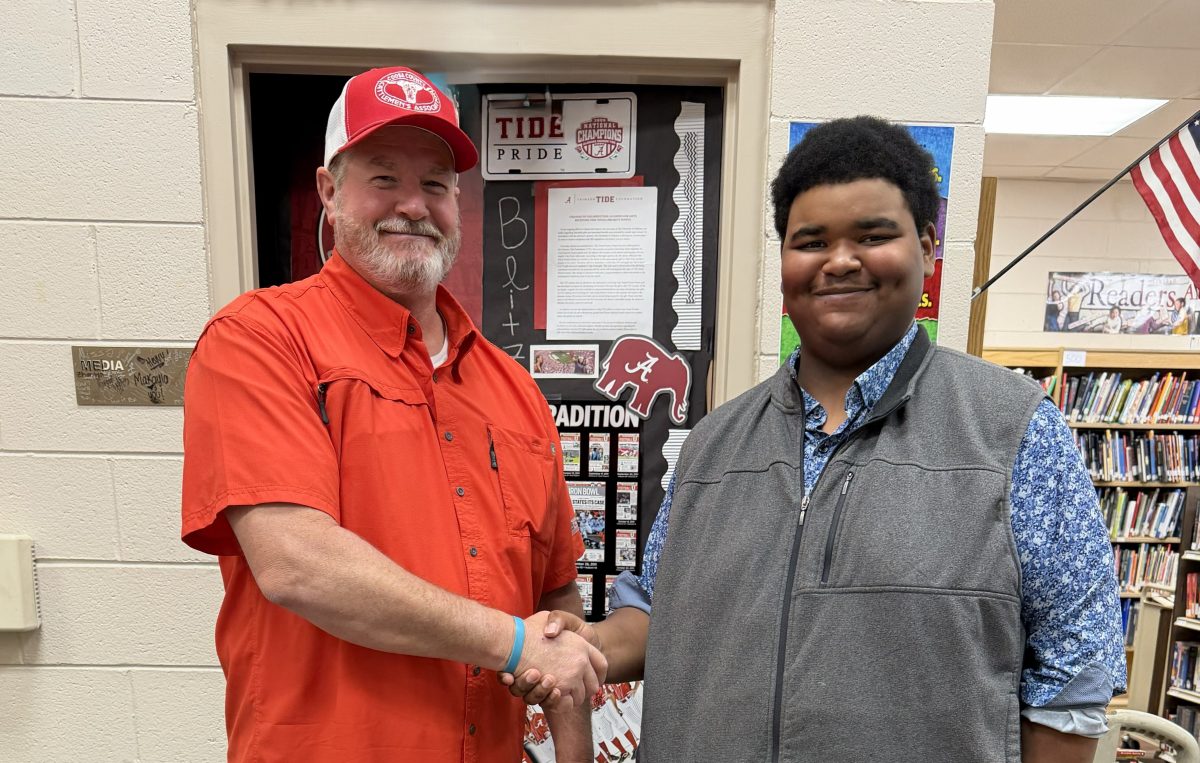
Commission Chair Lamar Daugherty, left, with Central High School SGA member Christopher Prowell.
By Christopher Prowell
Central High School Student Government Association member Christopher Prowell has been conducting interviews with Coosa County Commission candidates recently, following his interviews with other candidates.
In last week’s edition, Prowell reported on his interviews with District 4 Commission candidates Matthew Reams and Johnnie Schmidt.
In a third interview, Prowell spoke with Coosa County Commission Chair Lamar Daugherty who discussed his values, leadership experience and qualifications for continued service to the county.
Daugherty, who currently serves as chair of the County Commission, emphasized that his lifelong residency in Coosa County and decades of public service have shaped his approach to leadership. He pointed to more than 30 years of experience working with Central Alabama Electric and maintaining working relationships with local, state and federal officials as key preparation for his role.
He said those relationships have helped the county secure support and attention from higher levels of government, especially in addressing infrastructure, utilities and rural development needs.
Daugherty described Coosa County as a rural community facing long-term population decline and a shrinking tax base. He explained that while the county has more than 10,000 residents, the number of active taxpayers is significantly lower when accounting for youth, elderly residents and those on disability. He said this creates ongoing challenges for funding essential services.
As chairman, Daugherty said his leadership philosophy is focused on practical problem solving, fiscal responsibility and preserving the rural character of the county while seeking new opportunities for growth.
He reflected on the county’s past, recalling a time when small towns across Coosa County had more local businesses, including convenience stores, repair shops and small service providers. He said consolidation and economic shifts have reduced those opportunities, contributing to younger residents leaving the area for work.
Daugherty said a strong rural county must focus on restoring opportunity through job creation, housing development and workforce training programs that allow young people to stay and build their futures locally.
He highlighted ongoing efforts to expand access to healthcare services, including telehealth programs and the reopening of essential services such as pharmacies. He also noted the development of a county ambulance service funded through tag fees, which he said has become a model for other rural counties.
On financial management, Daugherty said the county must carefully stretch limited resources. He described strategies such as rotating county equipment, reselling used machinery and reinvesting savings into new purchases to reduce long-term costs while maintaining services.
He said infrastructure remains one of the county’s greatest challenges, particularly roads impacted by heavy timber traffic. He emphasized the importance of balancing industry needs with the cost of maintaining public infrastructure.
Daugherty also addressed broadband expansion, saying improved internet access has helped residents work remotely, access services and generate additional tax revenue through increased online commerce.
He said one of the county’s most significant challenges is not only financial or infrastructural, but also public perception. Daugherty emphasized that negativity and distrust of local government, along with frequent disparaging remarks about the county, can have a real economic impact.
“How do you expect new businesses to want to come here when, whenever they inquire or shop around, they hear residents speaking negatively about the area,” he said.
He added that businesses look for communities that demonstrate confidence and pride in their future and that persistent negativity can discourage investment.
He said a positive mindset is essential for attracting growth, stating that industries are unlikely to invest in areas where residents themselves do not express belief in their community’s potential.
On economic development, he said Coosa County should focus on industries tied to forestry, outdoor recreation and tourism. He also pointed to the Highway 280 corridor as a key area for responsible growth that could bring jobs and business opportunities while preserving the rural nature of the majority of the county.
He expressed concern about large-scale land purchases by outside corporations, saying they often generate profits from timber and leases while providing limited direct benefit to local residents. He said future policies should ensure more revenue stays within the county.
Daugherty said workforce development remains a top priority. He emphasized partnerships with Central Alabama Community College and trade programs to prepare students for skilled jobs in construction, equipment operation and technical fields. He said restoring vocational education is essential to retaining young residents.
In emergency management, Daugherty praised coordination among county departments, including the Emergency Management Agency, Sheriff’s Office, volunteer fire departments, and utility providers. He said his experience in the utility sector has helped him understand disaster response and recovery planning.
He noted that pre-storm coordination meetings help ensure an organized response during severe weather events, even with limited staffing.
Daugherty also emphasized transparency and public communication, stating that county government relies on multiple methods, including public meetings, newspapers and word of mouth to keep residents informed.
He said disagreements among officials are handled professionally and noted that the current Commission has worked together effectively with minimal conflict.
In closing, Daugherty said serving as County Commission chair has been a continuation of his lifelong commitment to Coosa County. He said his goal is to preserve the county’s rural identity while building a more sustainable future through responsible leadership and community cooperation.
Prowell would like to thank County Commission candidates Matthew Reams, Johnnie Schmidt and Daughtery for taking the time to share their vision for Coosa County, which in turn has provided Prowell an opportunity to inform his student body on candidates running for public office as some seniors prepare to vote for the first time in this month’s primary election.