Don’t get hung up on paper

Editorial by Tonda F. Rush
It is easy to get hung up on the “paper” part of newspapers.
As a result, many who gather news from newspapers don’t realize the source of their information because they are not reading something on paper.
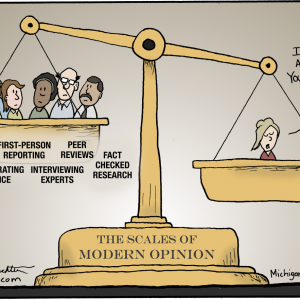
The important word is “news.” And the most trustworthy news comes from journalists, a class of First-Amendment inspired professionals that includes editors, writers and photographers contributing to thousands of titles all across America. They might be conveyed to you on paper.
Or they might be coming from a social media feed, a podcast, a text, a speech at an event or a newsletter. The operative word is news. And the value is reliability.
News from journalists didn’t always arrive on groundwood newsprint. Ancient Rome had clarions. Colonial America had pamphlets. Early US newspapers were printed on paper made of old rags. And, although paper made from spruce and pine trees has been the medium for much of our recent history, Americans have experimented with making “newsprint” from bamboo, hemp, straw and sugarcane. There was even an effort in southern California to use a fibrous plant called kenaf, to compete with the tree-growers.
But the paper was never the point.
What riveted Americans to “newspapers” was the quality of the information. In early days, only the wealthy could afford the six-cent price of “newspapers,” but along came the penny press of Horace Greeley and James Gordon Bennett Sr to produce newspapers for regular folks. In 19th century expansion, President Jefferson used newspapers to provide public notices to westward-bound Americans. He started an important trend of public notices in newspapers that continues today.
In their heyday, there were more than 10,000 newspapers-in-print in this country. That was back in the days of robust local retail, when Western Auto, JC Penney’s and the local grocery store used only the local newspaper to advertise their goods. Along came Sears, with a centralized advertising program, and then Kmart, Walmart and Amazon to push local owners out of retail markets.
With revolutions in local business came a loss in advertising, financial support for the local newspaper. The change has put more burden on readers and subscriptions to keep newspapers alive, but alive they are. From October 4-10, we celebrate them.
Scholars today say more than a third of newspapers have been shuttered. But that might be because they are counting only the daily press. On paper. There are many published weekly or monthly or only on websites or mobile phones.
Today, the local “press” is more of a euphemism than an image of ink on paper. Local journalists post to websites and mobile devices, that are boosted on social media and amplified by podcasters. Their stories may begin in print, but in today’s world, they are received by readers in dozens of ways.
What is important is the journalist behind the publication, the post, the one-liner and the audio.
The journalist is the one who did the research, vetted the sources, endured the editor’s skeptical blue pencil and put his or her reputation on the line for all to see the works. The journalist might be invisible by the time he or she reaches you, dear reader. But during National Newspaper Week, please take a moment to recognize the source of reliable information at your local news…paper, podcast, newsletter, or post. Subscribe if you can, patronize the current advertisers and support the folks whose lives are devoted to informing you.
Tonda F. Rush is a writer and lawyer in the Washington, D.C., area. She is a native Kansan and former CEO of National Newspaper Association.