
Economic value of family caregiving in Alabama reaches $12.8 billion annually, new AARP report shows
PROTECTED CONTENT
If you’re a current subscriber, log in below. If you would like to subscribe, please click the subscribe tab above.
Username and Password Help
Please enter your email and we will send you a password reset link.
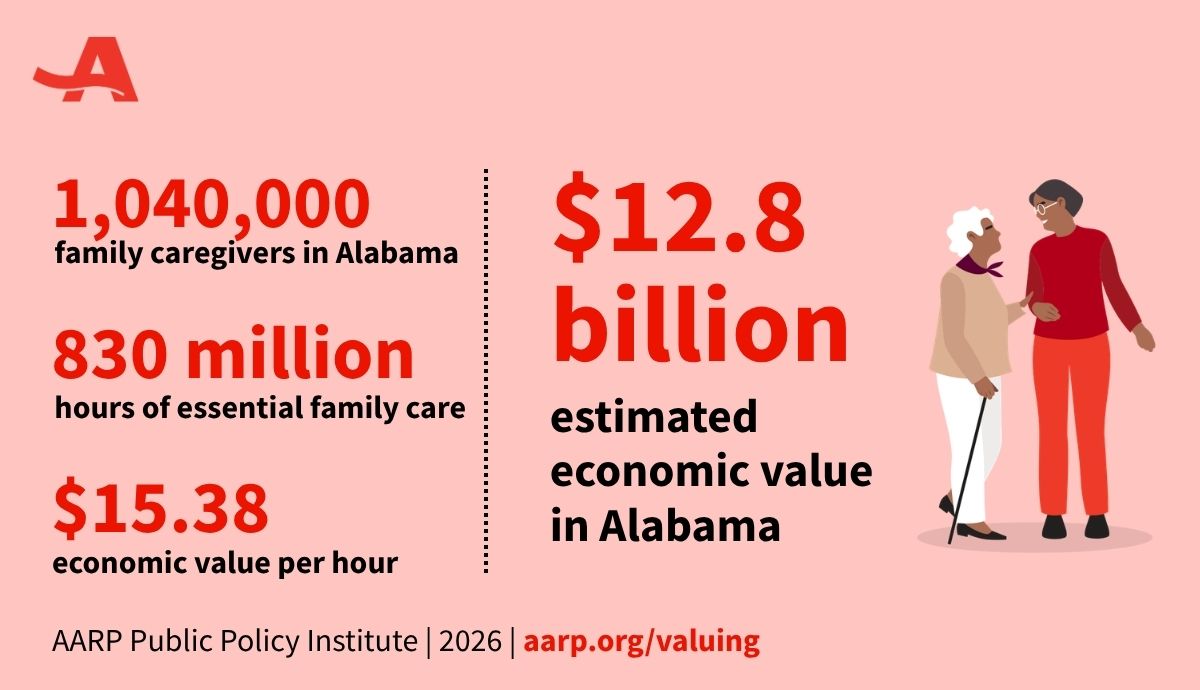
Report finds that 1,040,000 family caregivers of adults contribute 830 million hours of care annually, work that would be valued at $12.8 billion per year if paid in the marketplace.
Special to the News
Alabama’s family caregivers now provide $12.8 billion worth of labor each year, according to a new AARP report.
Most of this work is unpaid, yet it forms the backbone of the nation’s long-term care system that is essential to helping millions of older adults live independently at home.
Why this matters: Without family caregivers, many more Alabamians would rely on expensive institutional care, driving significantly higher costs for taxpayers and public programs.
“Family caregivers are a major economic force that fill critical gaps in our health care system,” said Candi Williams, AARP Alabama state director. “The economic value they provide now exceeds $12.8 billion annually, yet this care often comes at significant cost to caregivers’ health and financial security, and well-being. AARP is elevating this critical issue and fighting to save family caregivers time and money.”
Key findings from the report – “Valuing the Invaluable 2026” – include:
- 1,040,000 Alabamians are caregivers of adults, providing care for older parents, spouses, neighbors, and other loved ones, contributing 830 million hours of care annually, work that would be valued at $12.8 billion per year if paid in the marketplace, based on a value of $15.38 per hour.
- Across states, the estimated value of caregiving ranges from $14.12 per hour in Louisiana to $27.05 per hour in Washington, reflecting regional differences in wages and the cost of care.
National Findings:
- 59 million Americans are caregivers of adults, providing care for older parents, spouses, neighbors, and other loved ones, contributing 49.5 billion hours of care annually, work that would be valued at $1.01 trillion per year if paid in the marketplace, based on a value of $20.41 per hour.
- The 49.5 billion hours of care provided each year is the equivalent of nearly 24 million full-time workers, roughly 17% of the entire U.S. full-time workforce.
- The value of family caregiving exceeds total federal, state, and local Medicaid spending nationwide, and almost doubles all out-of-pocket health care spending.
Caregiving has become more demanding and complex as chronic illnesses rise and more care shifts into homes:
- Family caregivers are spending more time providing care, averaging 27 hours each week.
- More than half, 57%, now provide high-intensity care, meaning they spend more hours helping with daily tasks like bathing and dressing, as well as complex medical and nursing tasks like wound care and administering injections.
Read the full report at www.aarp.org/pri/topics/ltss/family-caregiving/valuing-the-invaluable-2026-update.
AARP continues federal and state advocacy to save caregivers money, time, and get them the support they deserve, including by supporting proposed legislation in Alabama that would provide a tax credit for family caregivers to assist them with out-of-pocket expenses that often add up to thousands of dollars a year.
AARP also helps families navigate caregiving challenges by connecting them to trusted resources. AARP Alabama’s resource guide helps family caregivers access key programs, services, and agencies right in their community. Additionally, through its partnership with United Way Worldwide, caregivers can access local support services in Alabama by calling 211, including help finding in-home care, respite care, transportation, and other essential services. To find out more, visit www.aarp.org/caregiving.
