Central SGA member interviews candidate for lieutenant governor, Patrick L. Bishop
PROTECTED CONTENT
If you’re a current subscriber, log in below. If you would like to subscribe, please click the subscribe tab above.
Username and Password Help
Please enter your email and we will send you a password reset link.
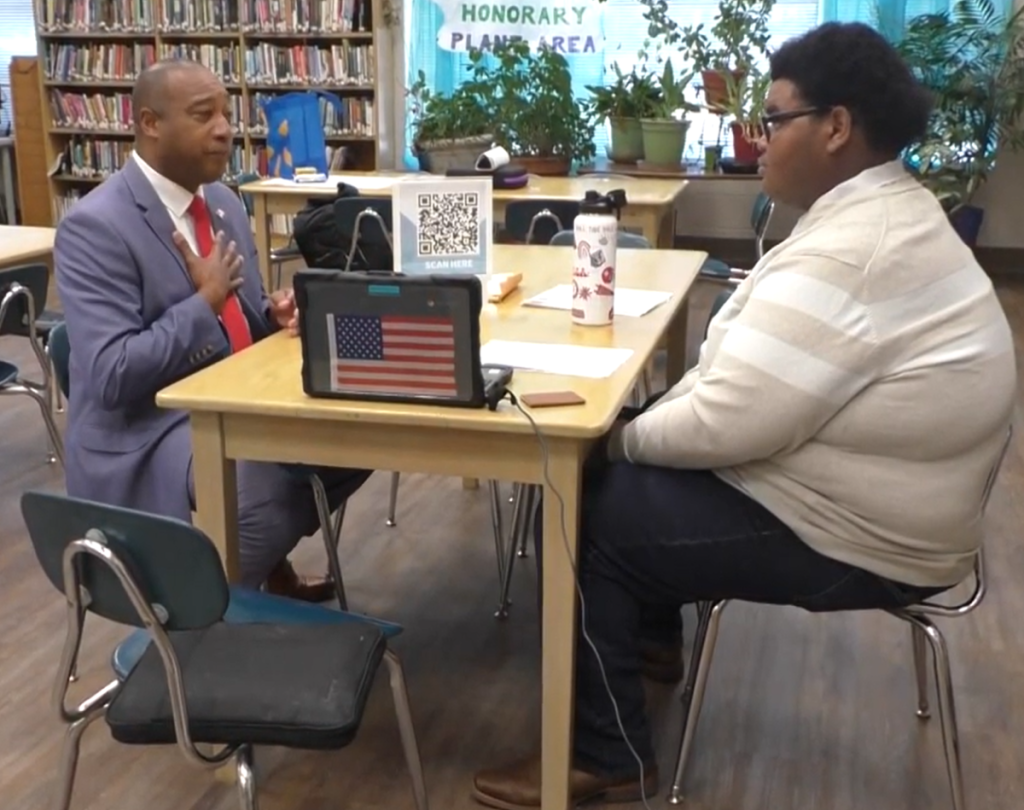
Central SGA member Christopher Prowell, right, interviews Patrick L. Bishop, a Republican candidate for lieutenant governor. Photo submitted
Special to the News
Central High School Student Government Association member Christopher Prowell is on a quest to interview Alabama’s pool of gubernatorial candidates and recently expanded his quest to include candidates for lieutenant governor, as well.
Prowell has contacted eight candidates from both the Democratic and Republican parties. Below is Prowell’s article from his interview with Republican candidate Patrick L. Bishop.
Veteran, officer, candidate Patrick L. Bishop shares his vision for Alabama’s future
By Christopher J. Prowell
Patrick L. Bishop’s story begins in Kingston, a Birmingham neighborhood near the city’s airport.
“I grew up in Kingston, Avondale, Woodlawn, that whole area,” he recalled.
After Jones Valley High School closed, he transferred to Ramsey High School, where he graduated before beginning a career that would span a couple of decades in uniform and public service.
His journey in both uniform and public service started with his first deployment. In 1990, Bishop arrived at Fort Bragg on a Friday. By Monday morning, he was in Saudi Arabia.
“Fastest weekend of my life,” he said with a laugh.
Enlisting as a private first class, he served as an 88M transportation coordinator, “basically a truck driver,” he explained. Then he became a Calvary scout and with that job held a government security clearance.
He left active duty in 1996 to care for his parents, but his service continued in other forms in the Army Reserve component.
Bishop joined the Birmingham Police Department and later the 20th Special Forces Group as an administrator and Imagery analyst, where he rediscovered his love for airborne operations. His military career accelerated, and in 2004 he earned his commission as a signal officer.
A year later, he was involuntarily mobilized during Hurricane Katrina operations, where he briefed the well‑known “Ragin’ Cajun” General Russell Honoré.
“General Honoré asked me, ‘Lieutenant, why don’t you do this full time?’” Bishop recalled.
That conversation led to full‑time active duty orders. He eventually transitioned into public affairs and anti‑terrorism, retiring in 2017 as a public affairs and anti‑terrorism officer for a two‑star command.
Today, Bishop serves as a school resource officer with the Cullman County Sheriff’s Department, a role he describes as “a job I truly love.”
Bishop is now seeking the office of lieutenant governor as a Republican, a role he believes carries two essential responsibilities: presiding over the Alabama Senate and being prepared to assume the governorship at any moment.
“You have to be ready to step into that seat at any second,” he said. “It’s the succession of command, something the military teaches well.”
If elected, Bishop’s top priorities would be education, veterans’ services and healthcare. He argues that Alabama has made progress in industries like automotive manufacturing, but still has significant room to grow.
“We can do better. We can be the next Detroit, the Detroit of the ’60s and ’70s, when they were the giants,” he said.
Bishop believes rural counties can thrive with targeted investment in construction, agriculture, logging, and manufacturing. He also sees opportunities for veterans and people in underserved communities to start small businesses, supported by accessible loan programs.
“If tax dollars are spent here, tax dollars will be used here,” he said, emphasizing the importance of keeping resources local.
As a longtime law enforcement officer, Bishop speaks bluntly about Alabama’s drug crisis.
“We have a serious issue with opioids and meth,” he said. “If we don’t get a hold on it, it will get a hold on us.”
He proposes an immediate task force combining law enforcement, pharmacies and agricultural regulators.
On healthcare access, Bishop argues that no resident should have to travel 30 or 40 miles for basic medical care. He believes major hospital systems would expand into rural counties if state and local leaders extended “the olive branch.”
“It just has to be done,” he said. “The meetings haven’t been had.”
Although Alabama ranks first nationally in pre‑K, Bishop notes the state falls near the bottom in overall K‑12 outcomes.
“We have to recruit quality teachers,” he said. He also emphasized the need for strong administrators, librarians and support staff and for transparent use of tax dollars.
Bishop’s experience as a former parole officer shapes his views on adult education, as well.
“There are people in the Department of Corrections who don’t have a high school diploma,” he said. “Once they get education and training, they succeed.”
With more than 20 years in law enforcement, Bishop believes crime prevention begins early.
“It starts day one, once a child enters this world,” he said. “We have to instill principles from the home, from the community, from the law.”
He supports mental health facilities for individuals whose criminal behavior stems from untreated conditions.
“We’ve done an injustice while trying to inflict justice,” he said. “We don’t need more prisons. We need better people running the prisons we have.”
Bishop also supports requiring GEDs or trade certifications before inmates are released.
“When they leave prison, they should be employable and paying taxes, not reoffending,” he said.
A strong supporter of the Second Amendment, Bishop still advocates for age restrictions.
“Just because someone can carry a gun doesn’t mean everybody needs to carry one,” he said.
He opposes handgun possession at age 19, noting that alcohol and tobacco both require a minimum age of 21.
For rural law enforcement, Bishop stresses the need for proper equipment.
“You can’t take a Crown Victoria down a back road with dips and ditches,” he said. “You need four-wheel drive vehicles and the right people in the right places.”
Bishop supports paper ballots and voter ID requirements, citing concerns about identity misuse.
“You can’t hack a paper ballot,” he said.
He also believes voter registration could be streamlined by linking it to driver’s licenses or high school graduation.
To ensure rural residents aren’t disadvantaged, Bishop calls for more polling locations and case-by-case absentee voting, especially for military members, hospitalized individuals and nursing home residents.
Prowell would like to thank Mr. Bishop for taking the time to allow him to interview him, which in turn will provide Prowell with the opportunity to inform his student body.