Donate life: Consider organ donation
PROTECTED CONTENT
If you’re a current subscriber, log in below. If you would like to subscribe, please click the subscribe tab above.
Username and Password Help
Please enter your email and we will send you a password reset link.
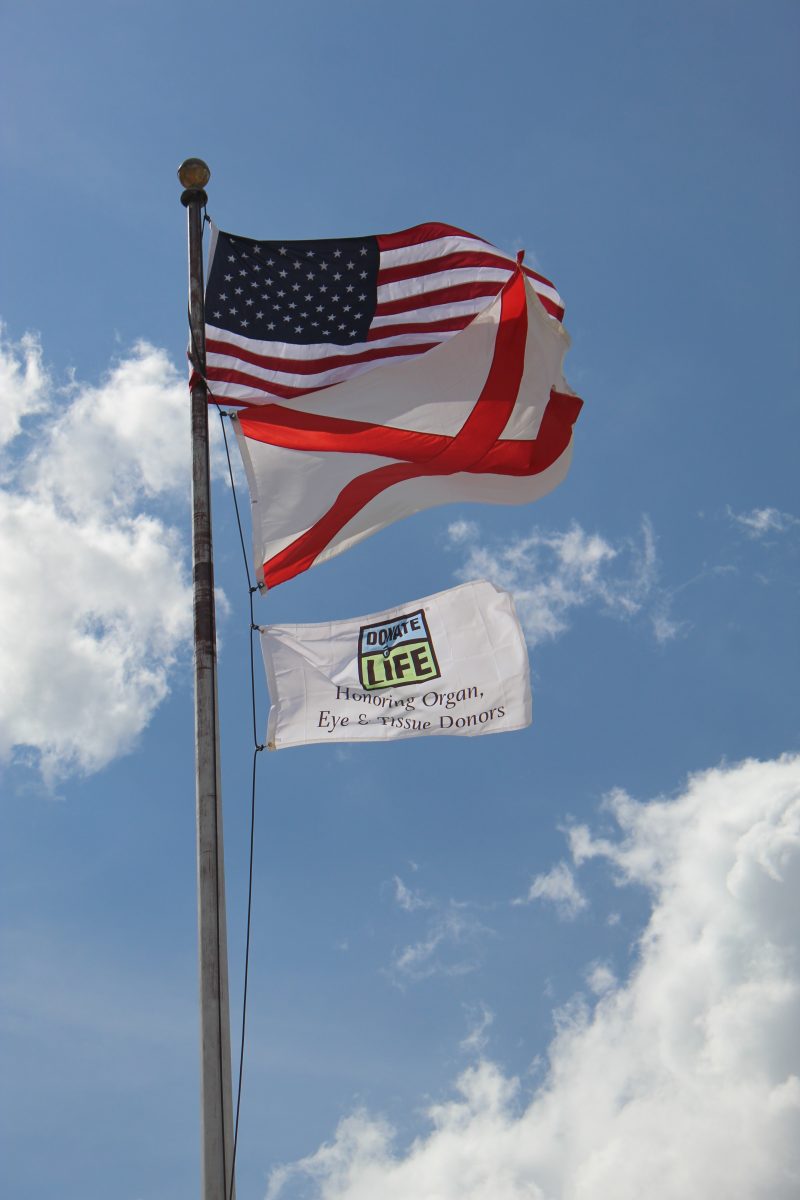
A third flag has been added to the flagpole at the Coosa County Courthouse, recognizing April as National Donate Life Month. Photo by Christa Jennings
By Christa Jennings
Senior Staff Writer
With the arrival of spring comes signs of new life and new beginnings, a fitting time to honor organ, eye and tissue donors and the lives they have saved.
April is National Donate Life Month, led by Donate Life America as an observance to focus national attention on the importance and need of organ, eye and tissue donation.
Having been established in 2003, this is the twenty-third year that National Donate Life Month is helping raise awareness about donation, encouraging Americans to register as donors and honoring those who have saved lives through the gift of donation.
Donate Life America recognizes that it is the generosity of donors and donor families that makes saving lives through transplantation possible. As such, the month honors both living and deceased donors and celebrates the lives they have saved.
Each year Donate Life America creates artwork to celebrate Donate Life Month, focused around a central theme, that is used in resources and events throughout the month.
This year’s theme is “Let Life Sing,” with artwork showcasing birds as they are known in many cultures as one of the most visible and welcoming signs of spring.
Donate Life America states, “They represent both new beginnings and visits from loved ones who have passed away. The yearly return of birds and their songs offers us a sense of peace and hope.”
According to data from the Organ Procurement and Transplantation Network, more than 100,000 people are on the national transplant waiting list for life-saving organ transplants. Last year, more than 48,000 transplants from 24,000 donors brought renewed life to patients, their families and communities.
The Organ Procurement and Transplantation Network also reflects that there are 1,208 candidates on the transplant waiting list in Alabama alone, with 1,012 of those waiting for a kidney and 173 for a liver.
Alabama has 83 candidates who have been on the waiting list less than 30 days, but 50 who have been on the list five years or more. The greatest amount of Alabama’s candidates, 277, has been on the waiting list between one and two years.
With another person being added to the national organ transplant waiting list approximately every 8 minutes, many do not have to look far to discover someone who is on the waiting list or who has been impacted by organ donation, either as a donor or a recipient.
One such individual is Coosa County Administrator Amy Gilliland, who is happy to share her story of how the generosity of others helped save her life through organ donation.
Gilliand was diagnosed with systemic lupus in 2006, which greatly affected her kidneys. Within months she was in end-stage renal failure.
While teaching full-time at Central Alabama Community College and finishing graduate school at Auburn University, she was placed on dialysis. Her doctor worked around her schedule and arranged for the dialysis unit to open at 3:30 a.m., and she would dialyze three days a week from 4 to 8 a.m. so that she could start teaching class at 9 a.m.
“Dialysis was just an added part of my day,” Gilliland said.
She also knew that she needed to deal with this life change before telling people.
“I knew I would need a transplant to halt the lupus and live a normal life, but my blood type is O+, and they have the longest wait on a transplant list,” she said. “My best hope was to receive a kidney from a living donor.”
Gilliland said she was “not about to solicit for a kidney,” but numerous friends and family members approached her about donating blood and being tested to be a living donor.
“I was shocked and humbled,” she recalls. “I mean, that’s a body part that you’re willing to give me! Did they really understand what they were saying?”
Thus began Gilliland’s journey on the road to her first organ donation and transplant.
Typically a person is on dialysis at least a year before UAB Hospital will even see if they are qualified just to receive an organ. However, UAB called Gilliland after six months, and she passed all the tests.
For the next step in the process, UAB contacted potential donors, with the first person on their list being Gilliland’s friend Tara Giddens. She went to UAB for testing and discovered that she was a sister match to Gilliland.
“It was amazing – I have no siblings,” Gilliland said.
UAB was satisfied with the results and did not call other potential donors to be tested. Within three months Gilliland and Giddens were scheduled for their surgery.
The transplant was an immediate success, and Gilliland ended up only being on dialysis for nine months.
“I received Tara’s kidney on September 30, 2007,” she said. “I felt great and have had no issues. I get monthly labs drawn at my local doctor’s office to check certain levels, and I go to UAB once a year for a wellness visit.”
Since Gilliland was a Type 1 juvenile diabetic, her doctor wanted to transplant a pancreas to cure her diabetes and to help the kidney transplant. Her journey toward a second organ transplant began.
However, a pancreas can only be transplanted from a deceased person. After having the successful kidney transplant for four months, she was placed on the pancreas transplant list.
“I had to just stay ready and wait on a call,” she said. “On December 1, 2008, UAB called, and I had two hours to get there.”
Gilliland was taken to a room and prepped for the surgery. At the time she had no idea where the organ came from, only that it was from a male because a young boy was called for the liver.
“After 31 years of being a diabetic, suddenly I wasn’t,” Gilliand said. “When the doctor told me that the pancreas would last a very long time because it was so young, I just broke down. I knew a mom had made a courageous decision to donate her child’s organs.”
Five years later, she received a letter from Deborah King, Cameron’s mom, who donated his organs and provided Gilliland with the pancreas transplant.
King wanted to celebrate what would have been Cameron’s sixteenth birthday that year.
“My family and I went to Gulf Port, Miss., to meet her, and it was a celebration,” Gilliland said. “We met the girl who received his heart, and Deborah was able to hear her son’s heartbeat. It was awesome.”
Gilliland is truly grateful for the new life she has been given through organ donation and transplantation, and she does not take it for granted.
“Organ donation reversed the lupus I once had, and I am no longer diabetic,” she said. “I feel good and am probably in better shape and health than a lot of people. It truly saved my life and so many others. Yes, I am careful about things – there are certain foods that I can no longer eat, and my immune system is compromised so I avoid sick people as much as possible, but overall, I am healthy.”
When asked what she would most want people to know and understand about organ donation, Gilliland explained that it is not the end, but rather a new beginning.
“Do not fear organ donation,” she said. “Your life isn’t over when you are a live organ donor or when you receive an organ. For many, it is just beginning! I never stopped working or doing my normal activities. It is not a disability.”
She added, “There are so many myths about what is done to the deceased body of organ donors. Deborah purposely had an open casket for her son to dispel those rumors. Know the facts.”
Gilliland encourages individuals to contact the organ and tissue service in Birmingham, Legacy of Hope, at 800-252-3677 for more information.
Individuals can also support organ donation by purchasing a Donate Life vehicle tag.
Gilliland urges those who can, “Donate Life! Be an organ donor.”
Her case of needing a kidney is an all too common one. Kidneys are the most needed organ, with 86% of patients on the waiting list waiting for a kidney.
The average waiting time for a kidney from a deceased donor is three to five years. However, a kidney from a living donor offers patients an alternative to years of dialysis and time on the national transplant waiting list.
While being able to help save others, the living donor’s remaining kidney will increase in size and function, compensating for the loss of the other kidney and allowing the donor to live a healthy life with just one kidney.
Additionally, 9% of patients waiting are in need of a liver, and a living donation of just part of the liver can help these patients. The remaining portion of the donor’s liver will regenerate within four months and regain full function.
Living donation is another way to help those waiting for a second chance at life. Learn more about organ, eye, tissue, and living donation at DonateLife.net, or visit Alabama’s Donate Life State Team website at DonateLifeAlabama.org.
You can register your decision to be an organ, eye and tissue donor at your local Department of Motor Vehicles when renewing or obtaining a driver’s license or online at RegisterMe.org.