Special to the News
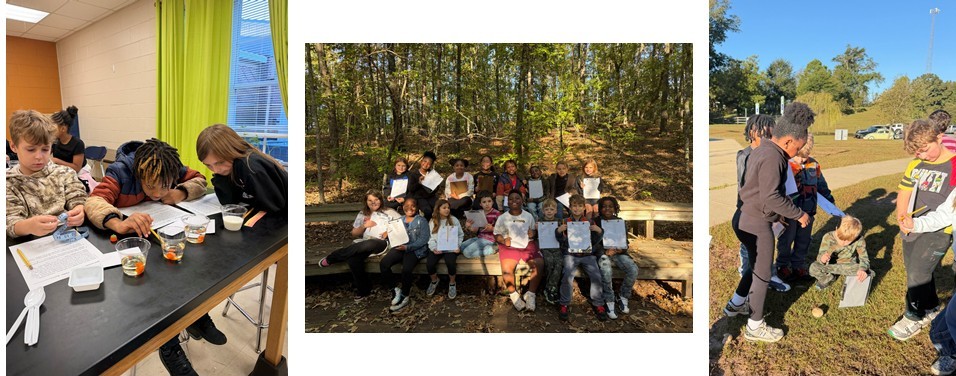
At Central Elementary School, third graders, led by their science teacher Mrs. Compher, contrasted the dissolving rates of candy pumpkins in water, milk, vinegar, and oil after writing their hypotheses.
The third graders also enjoyed the variety of outdoor learning centers around the campus as they went on a nature scavenger hunt visiting the fruit orchard, high school courtyard flower garden, the arboretum, and the outdoor classroom. The students did a great job of being still and quiet so they could hear and identify the sounds of the forest.
Fourth graders, led by their science teacher Mrs. Lea, conducted an experiment using marshmallows and toothpicks to contrast the differences between an exoskeleton and an endoskeleton.
The fourth graders also went on a Nature Ecosystems Scavenger Hunt. They identified and enjoyed playing in the long branches of the willow tree; they also identified birds and observed their nests, as well as ants in their ant hills.
In addition, they contrasted simple and compound leaves and identified mosses and mushrooms. They also learned an important life lesson on how to recognize poison ivy with the idiom, “Leaves of three, let it be.”
Fourth graders also dissected pumpkins, counting the seeds and creating bar graphs to display their results.
Fifth graders, led by Mr. Walker, identified the physical and chemical properties of baking soda, starch, salt, water, iodine, and vinegar. Then the young scientists performed several chemical reactions to test their properties.
Fifth graders also used different colored marshmallows to create atomic models for the first 10 elements on the periodic table. The marshmallows were the electrons, protons and neutrons. Then, they used the marshmallows and toothpicks to create molecules.
The high school chemistry students had the opportunity to teach first graders in Mrs. Ware’s, Mrs. Zachary’s and Mrs. Chappell’s classes. The chemistry students led the young scientists in conducting a candy pumpkins dissolving experiment.
The chemistry students closed out the lesson by reading a book about pumpkins to the students. It was a great learning and interdisciplinary lesson for both the elementary and high school students.
Thank you to Coosa County Schools science coach Shelley Wood for sharing pictures and information and coordinating lab activities with our science teachers.