Nature Conservancy to dedicate state’s new 1,000-acre creek preserve at Flagg Mountain with special Earth Day event
PROTECTED CONTENT
If you’re a current subscriber, log in below. If you would like to subscribe, please click the subscribe tab above.
Username and Password Help
Please enter your email and we will send you a password reset link.
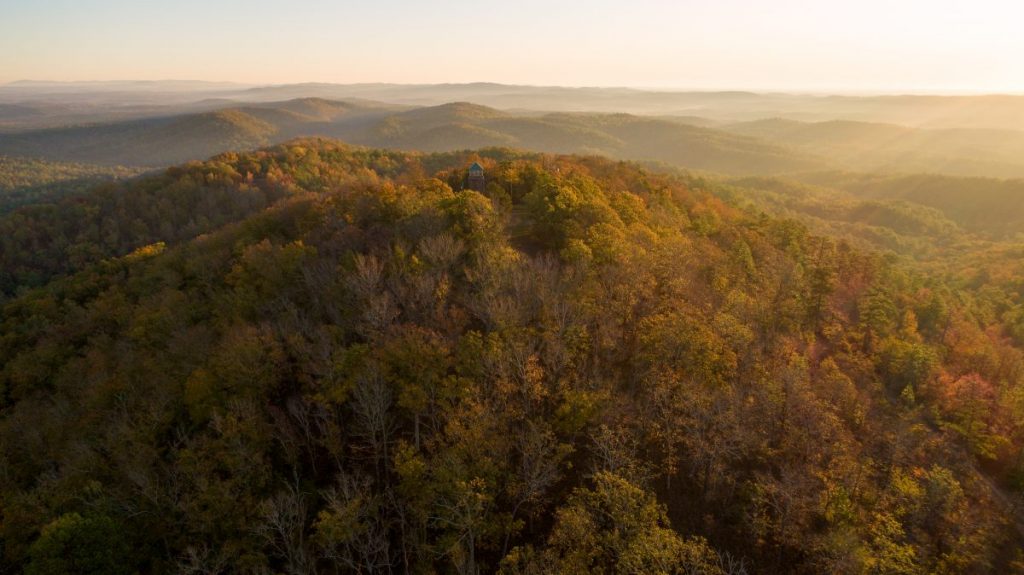
A bird’s-eye view of Flagg Mountain in Weogufka. Photo by Hunter Nichols
By Christa Jennings
Senior staff writer
The Nature Conservancy, or TNC, in Alabama will hold an Earth Day dedication for its new Fenvkvcēkv (pronounced finuh-guh-jee-guh) Creek Preserve at Flagg Mountain in Weogufka today, April 19, from 10 a.m. to noon.
The 1,000-acre tract’s name honors the Muscogee People, the original caretakers of the land, and is the original Muscogee, or Maskoke, name for the bordering and ecologically rich Finikochicka Creek.
“Establishing an entirely new preserve in our state is as special as the people and the heritage its acreage and name honors,” said TNC Alabama State Director Mitch Reid. “We couldn’t imagine a better day than Earth Day to dedicate this area and to illustrate our commitment to its preservation for generations to come.”
Flagg Mountain is identified as being home to one of the “rarest landscapes in North America,” the montane longleaf pine, which is only found in the southernmost region of the Appalachians and piedmont of northeast Alabama and northwest Georgia.
“This area, specifically, has long been a priority for protection, and through the efforts of The Nature Conservancy, the Conservation Fund and other partners, the conservation footprint around Flagg Mountain continues to grow; we are privileged to have the opportunity to protect these lands and waters in perpetuity,” said Reid. “We are especially grateful to The Conservation Fund for donating 315 acres that is being included in the preserve.”
Reid stated that Fenvkvcēkv Creek Preserve at Flagg Mountain will significantly contribute to conservation efforts of the biologically rich watershed and old-growth montane forests. It will also serve to demonstrate and guide restoration efforts on the broader landscape.
In addition to its montane longleafe pine forests, Flagg Mountain is also the southernmost peak and beginning of the 2,000-mile-long Appalachian Mountain range. TNC has identified this particular landscape, which stretches from Alabama to Maine and on into Canada, as one of the “most globally important places of focus for conserving biodiversity for the health of people and wildlife on a local, regional and global scale.”
“Due to its location, Fenvkvcēkv Creek Preserve and Flagg Mountain itself are essential to TNC’s vision of building a resilient and connected network of lands from the Gulf of Mexico into the Appalachian Mountains,” Reid said.
The Fenvkvcēkv Creek Preserve will expand an existing network of protected lands around Flagg Mountain. Building on a decade of conservation work in the region, The Nature Conservancy purchased two tracts of land adjacent to Flagg Mountain to establish the 1,000-acre nature preserve.
The new preserve at Flagg Mountain connects to existing protected lands and, according to TNC, “creates a key link in a migration corridor stretching from the Gulf of Mexico into the Appalachian Mountains.”
TNC states that, “Creating this nature preserve represents a strategic conservation win, adding to a growing network of protected habitat – more than 4,000 acres – in and around Flagg Mountain. Specifically, the Fenvkvcēkv Creek Preserve at Flagg Mountain anchors a corridor of resilient lands that connects the Gulf of Mexico and the Appalachian system through the Talladega National Forest and the Dugdown Corridor in Georgia.”
TNC recognizes that the Appalachians are a migration pathway and breeding habitat for migratory birds, as well as mammals such as black bear, bobcat and moose.
Information provided from TNC states, “As the climate changes, scientists expect more bird and wildlife species will also have to adapt, moving northward into the Appalachians. With biodiversity at risk, there’s an urgent need to establish these types of connected wildlife corridors around the world.”
Over the last decade, TNC has expanded conservation work on Flagg Mountain, including reintroducing prescribed fire to the landscape in 2019. By establishing Fenvkvcēkv Creek Preserve, TNC hopes that its involvement in improving forest management of surrounding areas ensures they are restored, “becoming more resilient to climate change and, in turn, providing enhanced carbon capture.”
The Fenvkvcēkv Creek Preserve now expands an existing network of protected lands, as it is adjacent to those owned by Forever Wild, The Conservation Fund and the Alabama Forestry Commission. TNC plans to use the preserve as an important demonstration site to guide management and restoration of these neighboring protected lands.
“If you recognize what we have, and if you understand what’s at stake, then I don’t know how you would approach this without doing everything you can to make sure that this vision is successful,” Reid said.
Flagg Mountain and the surrounding lands are also important to the Maskoke People, including those who returned to the area to start an ecovillage, having a community of indigenous Maskoke who practice linguistic, cultural and ecological sustainability. That is one reason it was important to TNC to name the preserve in honor of the Maskoke People.
Marcus Briggs-Cloud, a Maskoke person who is a son of the Wind Clan and an in-law to the Skunk Clan, mentioned the traditional homeland in Weogufka. He spoke about their people being forcibly removed from the area in 1836 during the mass genocide between 1814 and 1836.
Briggs-Cloud said that nearly 30% of their Makoke people were murdered and that they are the descendants of those survivors.
In an interview provided by TNC, Briggs-Cloud explained that the impetus for the creation of their community in Weogufka, Ekvn-Yefolecv (pronounced ee-gun yee-full-lee-juh), is language revitalization.
He stated that daily interface with the “settler colonial societies” that have an abundance of vocabulary that the Maskoke language doesn’t have renders their own language obsolete.
“Urban environments exponentially breed vocabulary faster than what our language can keep up with, so we needed to recreate this environment where we could speak our language every day, create a container for it where we draw on our traditional lexicon and do the activities that are considered traditional to our people,” Briggs-Cloud said.
About 11 years ago he said they started going “all over [their] traditional homelands” looking for land that they could reclaim. He added that they looked at different parcels of land for three years.
“We came here to this place in Coosa County, and everybody commented on how much we felt the presence of the ancestors here drawing us in,” he said. “The late matriarch of our community, Vlahoke, she was feeling the urge to call the community together, and she said, ‘I want to go back to that place in Coosa County. There was something really special about it.’ So we did; we came back here. Again everybody just commented on this pull of the ancestors from the forest. Three days later my cousin that does U.S.G.S. mapping of culturally significant sites, he said, ‘That place you’re looking at down there in Coosa County, that’s our ancestral village site, [Weogufka].’ We said, ‘Ah, no wonder the ancestors are calling us here.’ We all agreed we wanted to pursue this land, and after two years we were able to find a down payment as part of a competitive grant process.”
Briggs-Cloud further explained that the term “Ekvn-Yefolecv” embodies a double entendre as it means “returning to the earth” and “returning to our homelands.”
At Ekvn-Yefolecv they created a space where they can speak their language every day. Briggs-Cloud said the ecovillage is now home to the only fluent Maskoke-speaking children on the planet.
He added that they now have three generations of Maskoke speakers in the community, “breathing new life into the language and giving a sense of hope that the language won’t die as it was projected to in about 20 years.”
For more information on The Nature Conservancy in Alabama and how to support its projects, click here.
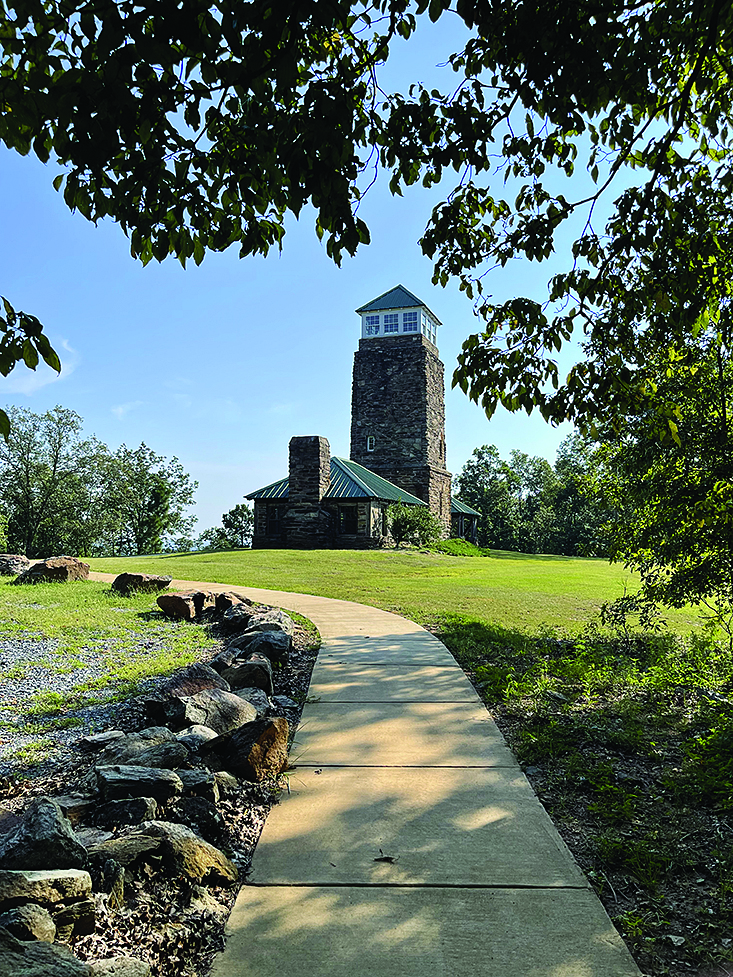
The historic fire tower at Flagg Mountain. Photo by Michelle Little

Weogufka Creek at Flagg Mountain. Photo by Hunter Nichols