Rockford Utilities considers gas service, employee performance
PROTECTED CONTENT
If you’re a current subscriber, log in below. If you would like to subscribe, please click the subscribe tab above.
Username and Password Help
Please enter your email and we will send you a password reset link.
By Christa Jennings
Senior Staff Writer
During a nearly two hour long meeting last Monday night, the Rockford Utilities Board heard a presentation regarding a fee-based service relating to its gas services, considered employee job performance and discussed other matters relating to the town and the board.
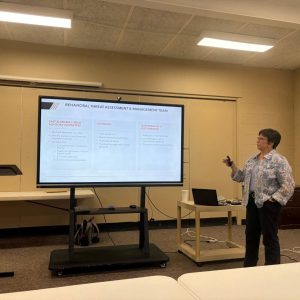
Bill DeFoor, director of the Municipal Gas Authority of Georgia, and Chris Welborn, senior regulatory compliance analyst with the gas authority, attended the meeting to present the board with information regarding the Subscribed Regulatory Compliance Service, or SRCS, a fee-based service offered by the gas authority to publicly owned natural gas operators in Georgia, Alabama and Florida.
DeFoor addressed the board for the presentation, reviewing the scope of services the SRCS provides, including multiple services within the areas of records management, operator qualification, report preparation, regulatory representation, and master manual development.
Regarding the regulatory representation, DeFoor said they know that small systems cannot send people to the regional and national meetings to stay up to date with regulations and any pending changes.
“We attend those and act as a conduit between you and the national organization,” he told the board. “Those national organizations are really important in the rule-making process.”
“The folks in Washington don’t even know that the Rockford system exists, and when they write a new rule it’s tailored to Transco and the interstates or Spire, but the same rules apply to you,” he added. “We try to make sure in the rule-making process they understand the small systems will be affected by these rules just like the large ones.”
Regarding inspection assistance, he said that they help prepare for Alabama Public Service Commission staff to come in and conduct inspections. He said that if a response is needed then they can assist with the preparation of a response.
Utilities Superintendent Wade Brown said that all 10 plans and manuals listed under the SRCS scope of services for master manual development are plans that he “has to keep up” and that they are part of his inspection every year.
DeFoor went on to provide information on the SRCS’s current subscribers, which include 72 municipalities, nine of which are in Alabama. He said Sylacauga Utilities Board is their newest subscriber.
In reviewing the fees associated with the service, he said that the one-time fee would be a total of $3,172.62. That includes the base fee of $6,000 and a total meter fee of $345.24 for the board’s 137 customer meters.
The annual subscription fee would be a total of $11,135.17 for the full year, which is billed monthly. That reflects the base fee of $10,735 and a price of $56.82 for the mains fee for 6 miles and $343.35 for the total services fee.
However, since the board would be joining later in the year, that annual subscription fee would be $5,344.88 for May through December.
As such, that meant the total for the board would be $8,517.50 for May through December, including the one-time development discovery fee and annual subscription fee.
DeFoor answered questions from the board and had much discussion with them regarding the services. He said that it has become a data driven industry and that it is “more and more about documentation, manuals, plans, processes, and procedures.”
Utilities Superintendent Brown stated that over the last couple of years Randy Hammond, gas pipeline safety investigator with the Alabama Public Service Commission, and his boss, when doing Rockford’s inspection, have suggested the Utilities Board get involved with the SRCS.
“[They] have strongly stressed to us getting involved with this just to keep us out of trouble with the federal government because of regulations that change that we’re so small we don’t know about,” Brown said.
Board Chair Ronnie Brown said, “To me that seems like a lot of money for just 137 customers.”
Board Member Ronnie Joiner said, “My question is this, what’s different about gas today than it was 20 years ago? It still burns the same. It’s still as dangerous as it was. Why all of this stuff? This looks like a bunch of bureaucratic stuff to me that people have made up to make themselves a job.”
DeFoor said that “a lot of the regulations are passed down at the federal level” and that they apply to all gas operators everywhere.
“It doesn’t make gas any less dangerous or any safer, to me,” Joiner said. “We all know what it will do. That’s just my opinion.”
“I hear you with that, and the rules that apply to Spire and Transco and Rockford in many cases are the same and don’t recognize your staffing and your resources,” DeFoor said. “I can’t say that they’re all excessive; some are.”
In further discussion, DeFoor stated that he would say that their service is unique, adding that there is no comparable service in the area to what they offer.
Chair Brown asked Hammond, who was in attendance, for his input during the discussion.
“In the last – since I’ve been there, 11 years – the regulations are changing regularly, and we now have a new acting director,” Hammond said. “Our last director retired. Now we have an acting director, and everything’s changing with the director. We’ve gone from our normal inspection formula, that we come normally every year and do on Rockford’s inspection is 42 questions long. Now the new formula that we’re having to use is 36 pages long. It’s all about regulations. It’s all about paperwork. It’s not about what gas is or what gas has been 30, 40, 50 years ago. It still burns the same, but now it’s all about paperwork. It’s all about compliance and regulations. Every time there is an explosion or a fire or somebody gets hurt or dies, a new regulation comes out from that incident. They’re becoming more paperwork driven.”
Hammond added that as a member of the gas authority, every year the Rockford Utilities Board gets a dividend check that comes back directly to the board. He said that he was not sure what that was now, but that when he was there 11 years ago it was typically between $6,000 and $8,000 every year.
Hammond said that could cut “a lot of the cost” of the SRCS or would at least help offset the cost. Utilities Clerk Deanna Lesley said that she thinks the dividend check is now about $2,000 but that she would double check.
In further discussion regarding giving his input to the board, Hammond went on to say, “It’s becoming more regulation and more paperwork driven. That’s the purpose. They can keep up with it because they attend the meetings I attend and go to a couple meetings I can’t go to. So they’re more up on the regulations and stuff ahead of me sometimes, actually. Here’s what I’m going to say, the acting director says – and it’s coming from your public service commissioners – that anything from now on they’re going to start fining people for anything that we find. If we come in there and some of your paperwork isn’t right, they’re going to give you just so many days to fix it, and if you can’t fix it by then they’re going to fine you. That’s what the federal government wants them to do.”
Hammond added that they are also on a 20% rotation basis starting this year and said that now instead of traveling just from Montgomery to Birmingham, he has to travel the entire state. As such, he said that in the next two or three years Rockford will have other inspectors.
“We try to help people like Rockford, Sylacauga and Alex City – the guys in the south, if you get them, you can forget it,” he said. “They’re looking to write you up. They’re not here to help you. They’re here to write you up.”
Chair Brown mentioned that they do not make much money off of gas as it is, adding that at one time they even thought about trying to sell it to somebody because of how little money they make on it.
He said that he thought the board needed to table the matter to let everyone think about it and look over the paperwork provided to see what they think. However, he said the board would have to go up “a good bit” on individuals’ gas to pay for it.
Brown further said that with the “economy going like it is, it’s getting pretty bad.” He mentioned that the board had already recently increased gas rates, so it would need to think about it.
As such, after discussion the board unanimously approved tabling the matter.
Also during the meeting, Superintendent Brown said, “My thing, according to the law about executive sessions, I think y’all can go into executive session for a few minutes to talk about job performance of public employees.”
The board then dismissed into executive session for 10 minutes.
Following the executive session, Chair Brown said that they “have been discussing some about Wade and him taking on a lot of responsibilities, working on the building” and mentioned that he has been there 11 years, is certified in many areas and is the superintendent.
Brown further said that what the board is going to start doing for each employee is that whenever that employee’s anniversary comes up they are going to evaluate them and give raises at that point. He added that Wade Brown’s anniversary had just come up.
Joiner then made a motion to “give Wade the raise that he asked for,” and Board Member Raymond Abrams seconded the motion.
Chair Brown specified that the raise was for $3 an hour, and Brown’s requested raise passed by a majority vote. Board Member J.T. McDonald abstained from voting on the matter. While no effective date was mentioned in the motion, the approved raise means that Brown’s initial $24 an hour salary will now be $27.
After approving the raise, Joiner said, “The reason Wade brought this up is he went out and got a broad scope of what people were making, and he is nowhere near what the least one of them – well, he is now, but he wasn’t anywhere near what the least one of them made. It’s too close with the employees and the superintendent’s wages. It’s just too close. One of the employees only made a dollar less than he did.”
The board mentioned the superintendent having more responsibilities than the other employees.
“My job has changed a lot since I’ve been here,” Brown said. “I do a lot of things that I didn’t do, that Randy didn’t do.”
Chair Brown agreed, stating “it’s a lot of changes.”
In other business, board attorney Nancy Kirby said that she is still working with town attorney Tom Young regarding ownership of a trailer and backhoe. She said that the town provided a title to the trailer, so it is up to the board to provide proof of ownership to rebut that.
In discussion regarding the backhoe, she said that based on minutes from 1991, the town had approved making one-third of the payment for the backhoe, which indicates the town “helped pay for the backhoe to some extent.”
Kirby further said that the town claims one-third ownership of the backhoe and that the town wants to be bought out one-third of the value of it.
She mentioned it being up to the board whether it wants to offer to let the town purchase it for two-thirds of the value or if it wants to purchase it from the town for one-third of the value. She also mentioned they would need to get an appraisal to determine the value.
After discussion, the board said it would have auctioneer Chuck Bradley assess the value of the backhoe and proceed from there.
In other business, the board said it is waiting on concrete for its new building site at the intersection of U.S. Highway 231 and Circle Drive.
Chair Brown said they got a couple of prices for a pole barn, as well, and that the companies that provided the estimates are both about 10-12 weeks out. He said that the company that built the one at Ray, Addison Steel Truss, was the cheapest at $15,044 for a 40×60 pole barn.
Brown said the board needed to go ahead and approve it so that they can order it before the price further increases, as well as it taking 10-12 weeks to get the pole barn.
After brief discussion, the board unanimously approved going forward with ordering the pole barn.
In other business, the board also unanimously approved updating its bylaws in order to allow it to continue doing business with the new credit union that will be replacing First Bank.
The board also unanimously approved converting to EasyBill32 for its new billing software, which will replace CNI. Clerk Lesley said that it would be $150 per month with no additional fees.
In discussion, the board and Lesley mentioned that when customers go online to pay their bills, they need to go directly to www.rockfordutilities.com rather than typing it into an online search.
In addition to paying through the board’s website, customers can also mail their checks or money orders to Rockford Utilities Board; P.O. Box 8; Rockford, AL 35136; complete a bank draft for monthly payments; or pay it in person at Town Hall during business hours or via the drop box on the side of the building.
The next regularly scheduled monthly meeting of the Rockford Utilities Board will be held at 6 p.m. May 15.