Arctic blast hits Alabama, more cold on the way
PROTECTED CONTENT
If you’re a current subscriber, log in below. If you would like to subscribe, please click the subscribe tab above.
Username and Password Help
Please enter your email and we will send you a password reset link.
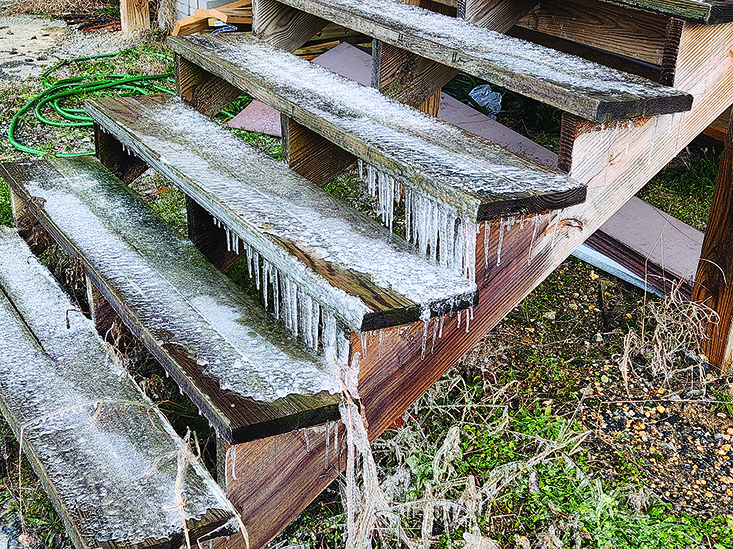
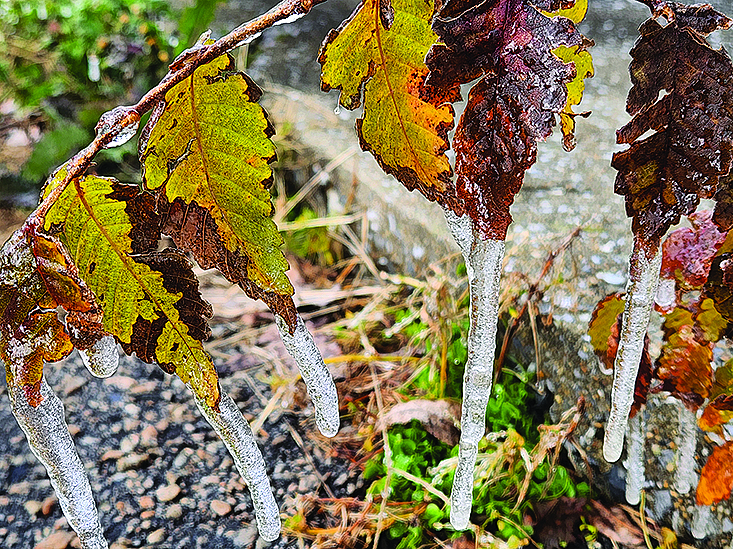
The bitter cold earlier this week left bridges and roads icy and left numerous steps and ramps covered in a layer of ice, making it more hazardous for some to leave their homes. Vegetation was also covered in ice Tuesday as Alabama residents dealt with unusually low temperatures. Photos by Christa Jennings
By Christa Jennings
Senior Staff Writer
An anticipated Arctic blast was felt throughout Alabama earlier this week, and more bitterly cold weather is expected over the weekend.
Following the cold weather at the beginning of the week, as of press time much of Alabama is also under a hard freeze warning from 8 p.m. today until 12 p.m. Saturday. The National Weather Service reports that sub-freezing temperatures as low as 14 degrees are expected across much of central Alabama.
NWS advises residents to take steps to protect tender plants from the cold. Additionally, to prevent freezing and possible bursting of outdoor water pipes, it recommends that they should be wrapped, drained, or allowed to drip slowly.
Additionally, NWS advises those with in-ground sprinkler systems to drain them and cover above-ground pipes to protect from freezing.
The Coosa County area is expected to have low temperatures in the mid-teens tonight, with tomorrow’s high being near freezing before dropping back to the mid-teens for the low once again. Sunday is forecast to be warmer, but still with a forecast low below freezing.
Monday temperatures will increase as Alabama is expected to have warmer weather and rain return early next week.
Many will be ready to welcome this warmer weather after dealing with such bitter cold temperatures this past week. On January 14, Gov. Kay Ivey issued a state of emergency for 25 counties ahead of this week’s winter weather.
Ivey stated, “We are anticipating unusually cold temperatures in Alabama this week, so I am urging everyone to be prepared, take caution traveling and stay weather aware.”
While Coosa was not one of the counties included in the state of emergency, following the holiday Monday many businesses, including government offices, also closed Tuesday because of safety concerns with icy roadways and bridges.
The National Weather Service reported that at least four Alabama cities had record cold temperatures on Tuesday, but that they were record low highs. NWS reported that Huntsville, Muscle Shoals, Birmingham, and Tuscaloosa all had record low maximum temperatures Tuesday, January 16.
Huntsville’s high was 21 degrees, which broke the record of 24 set in 2009.
Tuesday’s high temperature in Muscle Shoals was 22 degrees, which tied the record last set in 1927.
Birmingham’s high was reported at 27 degrees, breaking the previous record of 30 in 1977.
Tuscaloosa’s high on Tuesday was 28 degrees, breaking its previous record of 31 degrees, also in 1977.
Lows overnight Tuesday and into Wednesday morning ranged from 1 degree in Haleyville to 19 degrees in Dothan and Mobile, according to NWS.
The Alabama Department of Public Health is urging the public to know the signs and symptoms of hypothermia and frostbite and to take extra precautions during times of extremely cold weather, such as those being experienced in the state this week.
While no precipitation is expected this weekend, just sub-freezing temperatures, the ADPH advises individuals to seek care of experiencing symptoms because of prolonged exposure to cold temperatures.
Per ADPH, “Hypothermia is a medical emergency that can lead to death. Hypothermia occurs when the body’s core temperature falls below 95 degrees F, just a few degrees less than the normal body temperature. When exposed to cold, human bodies begin to lose heat faster than it can be produced.”
Additionally, ADPH warns about frostbite, an injury most common on exposed skin such as cheeks, nose and ears. However, frostbite can also occur on hands and feet.
Early warning signs of frostbite include numbness, loss of feeling, or a stinging sensation. If frostbite is suspected, individuals are encouraged to get the person out of the cold immediately and to slowly warm the affected area, but not to rub it since that can damage the skin. If numbness continues, ADPH advises to seek emergency care.
Signs and symptoms of hypothermia in adults include shivering, exhaustion or feeling very tired, confusion, fumbling hands, memory loss, slurred speech, and drowsiness. Signs of hypothermia in babies include bright red cold skin and very low energy.
ADPH states that signs that may point to frostbite include a white or grayish-yellow skin area, numbness, or skin that feels unusually firm or waxy.
If unable to get medical help immediately, ADPH recommends trying to warm the person up and doing the following:
- Get the person into a warm room or shelter.
- Remove any wet clothing the person is wearing.
- Warm the center of the person’s body – chest, neck, head, and groin – using an electric blanket, if available. Skin-to-skin contact can also be used under loose, dry layers of blankets, clothing, towels, or sheets.
- Warm drinks can help increase body temperature, but do not give alcoholic drinks. Do not try to give beverages to an unconscious person.
- After body temperature has increased, keep the person dry and wrap their body, including their head and neck, in a warm blanket.
- Get the person proper medical attention as soon as possible.
Guidance about prevention and care for hypothermia and frostbite is available at www.cdc.gov/disasters/winter/staysafe/hypothermia.html.
General guidance for freezing temperatures includes insulating pipes and allowing faucets to “drip a little” during cold weather to avoid freezing. Running water, even at a trickle, can help prevent pipes from freezing.
Individuals are also encouraged to learn or know how to shut off water valves in case a pipe bursts.
In case of winter storms, people are encouraged to restock or update their emergency kit and to always keep at least a seven-day supply of nonperishable food in their home and a gallon of water per person per day.
Individuals should also consider adding some supplies to their emergency kit in case of winter storms, including sand to improve traction and rock salt or more environmentally safe products to melt ice on walkways. The Environmental Protection Agency has a list of recommended products for that purpose.